


Chemistry OL Dr. MR
In Cambridge IGCSE Chemistry (0971), you will sit for three main papers: Paper 2, Paper 4, and Paper 6. Paper 2 is a multiple-choice paper (40 marks, 45 minutes) and counts for 30% of your final grade. Paper 4 is the theory paper (80 marks, 1 hour 15 minutes) and is the biggest part, worth 50%. Paper 6 is the Alternative to Practical (40 marks, 1 hour) and tests your experimental skills on paper — it makes up the final 20%. The syllabus has around 11 main chapters that cover the whole subject, starting from basics like the particulate nature of matter up to organic chemistry and industrial applications. To achieve the top grade (Grade 9 or A*), students usually need around 75–80% overall, though exact grade boundaries change slightly each year depending on the exam’s difficulty.
- Description
- Curriculum
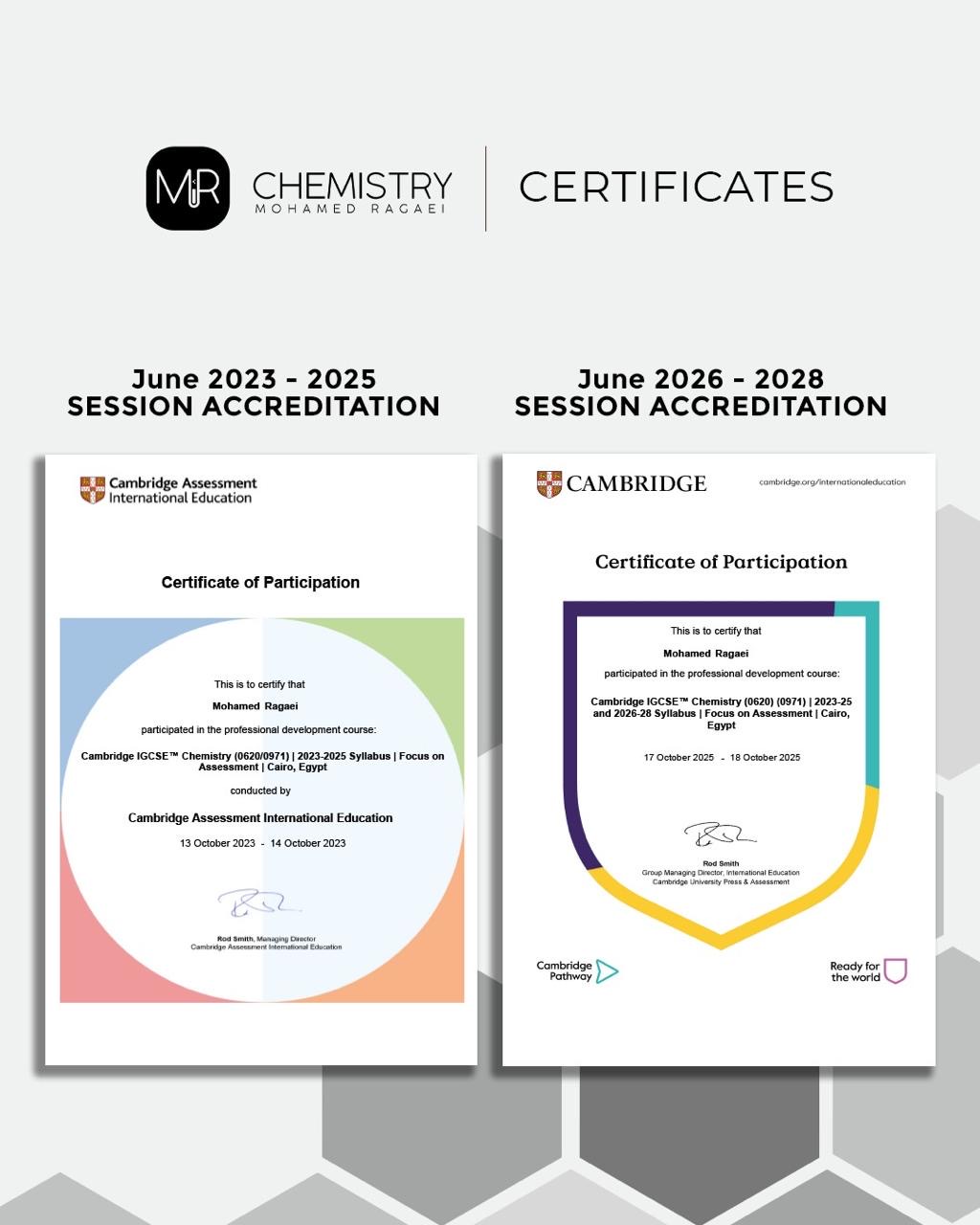
Hi everyone, I’m Dr. Mohamed, and I’ll be guiding you through your Cambridge IGCSE Chemistry journey. In this subject, you’ll be taking three main exams: Paper 2, Paper 4, and Paper 6. Paper 2 is your multiple-choice paper, and it’s 30% of your grade. Paper 4 is the theory paper — the biggest one — and it makes up 50%. Finally, Paper 6 is the Alternative to Practical, worth 20%, where you’ll be tested on experiments without actually being in the lab. Together, these papers test not only how much you’ve memorized, but also how well you understand, apply, and analyze chemistry.
The syllabus is divided into about 11 chapters, starting with the basics of matter and atoms, and moving up to exciting topics like organic chemistry and industrial processes. Each chapter builds on the previous one, so by the end you’ll see how everything connects. Don’t think of Chemistry as just “studying to pass the exam” — it’s a subject that trains your mind to think logically and solve problems, skills you’ll use in science and beyond.
Now, about grades: Cambridge sets the boundaries after each exam, but generally, to aim for a top grade (Grade 9 or A*), you should be scoring around 75–80% or higher overall. But I don’t want you to stress about numbers — our goal in this course is to make sure you understand the subject deeply, practice effectively, and build confidence step by step.
In my classes, I don’t just teach you the chapters — I break concepts down simply, give you smart exam strategies, and provide plenty of practice so you know exactly what to expect on exam day. Over the past 5 years of teaching, I’ve seen that the students who engage, ask questions, and practice consistently always achieve the results they dream of. And that’s exactly what I want for you.
So, if you’re ready to master Chemistry, not just to pass but to excel, let’s get started — and let’s aim high together. 🚀
